Introduction
Frugality is the quality of being frugal, sparing, thrifty, prudent, or economical in the consumption of resources such as food, time or money, and avoiding waste, lavishness or extravagance.
In behavioral science, frugality has been defined as the tendency to acquire goods and services in a restrained manner, and resourceful use of already-owned economic goods and services, to achieve a longer term goal.
Found on Wikipedia.
It has been a while since I wanted to write feedback on the 50+ conferences I’ve had a chance to sponsor in the past 10 years. https://marketingto.dev/ gave me the motivation I needed, with a Slack thread on “What are your do’s and don’t, success stories, and learnings for sponsoring/promoting at developer conferences?”, by Jakub Czakon (CMO neptune.ai, Founder developermarkepear.com).
I’ll give a strong focus to tech/dev conferences, scaling from a few hundred to thousands of attendees. A lot can apply to smaller-scale meetups, but it’s still a very different format, which potentially requires less investment on D-day, but a lot more upfront, since you’ll have to get your attendees yourself. Maybe another post in the future?
Disclaimer: The following is no cookbook. It is feedback, based on my experiences. It applies to sponsoring tech, and mostly developer conferences, essentially in Open Source communities, as a (an early) SaaS Start-Up company. Hence the “frugality” part, even though in my opinion, even bigger companies should all strive for frugality, for so many reasons.
Disclaimer #2: There’s no such thing as frugality in sponsoring conferences. They’re costly. They’re absolutely not carbon-impact-friendly (from travel to wasting disposable marketing collateral). Being really frugal would mean not sponsoring conferences (online conferences aren’t necessarily a good alternative, as I’ll expose later). But let’s still try to avoid waste as much as we can.
Index
OK, that being said, there are actually a lot of topics I’ll try to cover. It’s going to be an exceptionally long post for my blog, so I’ll try to structure an index below so that you can scroll directly to the parts that interest you most.
Why sponsor a developer conference
Obviously you’re not doing that just for the fun of it. As much as sponsoring an (Open Source project) conference is a great way of contributing to the project/community, even then, there must be something in it for you.
Let’s debunk something from the start
You won’t sell anything at a conference. It’s not the right place, not the right time. Unless it’s physical goods. Unless you decided to meet a prospect in the last sales step, so that you close the deal and celebrate with them in person. But that doesn’t count then; you already had closed the deal.
I would add: if you are at a developer conference, you’ll meet developers. And from my experience, they’re not really the persona that will happily discuss with someone trying to ask them for money bluntly (“Subscribe now!” on a roll-up is blunt).
So, depending on the stage you’re at, here is what you can achieve at such a conference:
- You can generate awareness about your product;
- You can build your brand image;
- You can build your network;
- You can generate leads;
- You can learn from and about a specific market segment, with first-hand insights that you’d have a hard time collecting through outbound emailing to try and get a call.
Each and every of the above has a lot of value when done right, and I’ll try to give tips and tricks about it below.
Why not sponsor other types of conferences?
Does the CES at Las Vegas seem like paramount? How about South by Southwest?
For my French-speaking readers, here’s a Downfall parody that sums up all I think about it. Disclaimer: I’m still looking at it from the perspective of an early-stage start-up, or any Series X start-up/scale-up that targets a highly specific niche.
Generalist conferences are just a waste of time and money in that case. It’s a bittersweet memory of mine: pitching about Blackfire, a PHP profiler, to a person who was on their way back from shopping, carrying a cabbage in their basket, who saw some light in the building and dropped by out of curiosity. And had no clue what PHP was. True story.
Even if it doesn’t get to that point, just one tip: if most of the sponsors are from the GAFAM, it’s probably no place for you. Qualify the conference target group, and make sure it matches your own target, as close as possible.
Another piece of advice: favor events where attendees have to pay for a ticket. Free events have a fair chance of attracting a crowd that is far too diverse so that you can hope to spend time with people matching your ICP.
Costs and Return on Investment
Even though we’re talking about frugality, you most of time won’t avoid paying fees to the organizers: it just makes sense, since such events are very costly, between the venue, the logistics, the staff, and the food and drinks (and sometimes to speakers).
Sponsoring packages
They’re always too expensive. Now, some, in my opinion, are just not worth it. I’ve been stunned when Covid hit and organizers turned to online conferences, to realize that they were offering packages at the exact same price, with less than half of the benefits for sponsors, and far smaller overall conference budget anyway.
If there’s one thing you should take away from this paragraph: dare to ask. If you truthfully believe that what the organizer offers is not worth the money, talk to them and find new, even creative ways. What I realized by doing that is that they’re actually very often thankful for the feedback. Not all of them have faced you challenges and needs as sponsors. Telling them what you need or would like to achieve will help them build better packages for all sponsors.
What you’re looking for is a way to engage with people, and ideally that you get a way to get back in touch with them after the conference. In a GDPR-compliant manner. No unrequested communication.
About IRL vs online conferences
Always keep in mind that online conference attendees have absolutely no reason at first to be exposed to your brand or product. In Real Life, it’s rather easy: food and coffee are usually near the sponsor booth. Online, food and coffee are right behind them in the kitchen, away from that screen they’re looking at too much during the day. Inter-conference slides with logos, or videos? Blah: Alt+TAB.
Low impact benefits
I’m not sure if there’s an actual secret sauce, silver bullet benefit that will get you those leads. Now here’s a list of the “sponsor benefits” that are worth not much in my experience:
- Social media blasts. As much as we all appreciate a “thanks a ton to Acme Inc, our sponsor”, why would that generate any leads? Brand exposure? Well, that tweet isn’t going to go viral, and you’ll have to hope that conference attendees or followers of the conference social handle actually look at their feed at the right moment to be exposed. And no, 3 or 5 blasts won’t change the game.
- Coupons/giveaways/special offers email blasts. It’s another story, but in self-service SaaS there’s rarely that urgency feeling of “ooooh, I need that tool right now, that it’s being sold cheaper”. We’re not in the retail industry, where the buyer and the user are one and the same person, craving for that new iPhone or pair of sneakers that will boost their ego. And in any case: an email with a dozen of those offerings gets yours lost in the crowd, assuming that devs will actually want to open an email stuffed with things they don’t like: pushy sales.
- Any brand presence that doesn’t include a link to your site. Yes, you want that logo on the roll-ups and the slides. But as long as you don’t have a click on a link or a flash of a QR code, including those UTM tags so you know exactly the source of the visit, you’re navigating in the dark.
So, how much should you pay?
There’s some trial and error here.
What is key is that, down the line, you should be tracking and comparing metrics across your acquisition channels, ultimately looking at the Customer Acquisition Cost. This article won’t get into the details of the calculation, since you’ll want to decide precisely how to do it and attribute given conversions to given channels, and how other channels might have contributed (common attribution models include: first touch, last touch, linear, time-decay, position-based, data-driven).
And of course, you should make sure your CAC matches your pricing model and Average Revenue Per Account.
Now, if it might help, my rule of thumb has been to stick between 5€ and 20€ per attendee, depending on how close the crowd was to my ICP.
In the end, it’s a little higher than what I was paying for highly targeted SEA, but there’s no doubt that getting in touch with a human at a booth is a lot more efficient than landing on a web page.
Tracking success
The conference is over. How do you know if it was worth it? There’s a fair chance that you don’t. There’s even a fair chance that you have the impression that it was a waste of time and money.
Of course, it is a legitimate question, and before even thinking of looking into success metrics, it’s great to collect the impressions of your team. There are a lot of things that might have happened that you were just not ready to measure, and any insight is a learning point for next time.
Because yes, there must be a next time. One thing that I have learnt: a single event is useless. Of course, there are some that you should straight up remove from your list for next year. Now it takes a while to build some presence. And in my experience, even a company with a small booth that nobody noticed the first time might become the “loudest” and most attractive, when relentlessly investing and showing their presence is rightful and beneficial to all. You’ll probably need at least 3 iterations.
Now in terms of metrics, one thing you’ll really want is one of those lead scanners. Hopefully this has been arranged by the conference organizer. It just makes things super easy: “before you go, can I scan your badge? I’ll make sure to get back to you based on our conversations”. Now of course, you should be picky. Scan only actual leads! You’re not trying to build your social media followers list.
Better than that, the best success metric I could track was the number of follow-up calls booked. It’s a rather easy sell. The person you are talking to is at a conference. They might be happy to meet you and interested in what you say, but they’ll meet dozens more people, listen to multiple talks. Just like you. So if they are interested in your product or service, they’ll be comfortable with scheduling a call in the next few weeks. And very often, since they’re at the conference for a professional reason, they have access to their calendar, either via their phone or a latptop. Just make sure that you have a Calendly link (or any other equivalent) at hand.
Plan B and C. If you can’t have any of the above, think of: a Google Form (particularly useful to take more extensive notes, and can be used in conjunction of the above), or your LinkedIn QR code (underrated and hard to find, but super convenient: open the LinkedIn app on your phone, press the search bar and find the QR code icon just below the search, on the right hand side, press it to show your code or scan someone else’s).
Basically, that’s it; you can only track who you met and had interesting discussions with. The CAC will take ages to calculate, just because of the time to conversion, even though it’s what you want at the end.
Logistics
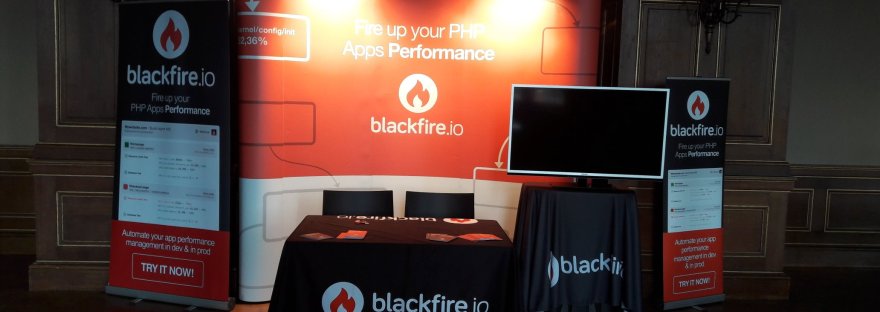
One of the most dreaded topics in conferences. Unless you raised a series C, you’re not getting that splendid hard-walls booth with the reception desk, the cushions, and the many flat screen TVs (we’ll cover that later). And you won’t pay for a carrier and logistics team to take care of everything for you.
It will be about carrying the stuff with you while travelling. It will be about being really early, or the day before at the conference, and making sure that if ever you ship something back, it is properly packaged and labeled before you drop it off or get it picked up. In that last case, expect things to get lost. It is inevitable. Who cares about your two roll-ups when the large booth next to you has crates standing on pallets? So if you can, I strongly advise that you carry your own stuff.
Ordering collateral in time
Makes sense, right? If you get it delivered directly to the conference location, however, the trick is to have it there not too early, nor too late.
Now, in all cases, never underestimate the delivery times and other delays. My take: everything should be ordered one month before a conference. OK, it’s more of a utopia, but the slower you are with it, the more stress for the team, the more focus you’ll have to give to such small operational topics in the last weeks before the conference, and the more money you’ll waste.
Inventory
As one of the frugality principles in sponsoring conferences (with a booth): waste as little as you can. Reuse those roll-ups. Keep the remaining stock of stickers or any sort of other swag.
And when you’re back from the conference: inventorize them! Make sure they’re still all in good condition. Make sure you know exactly what you have, and in how many samples. You might buy yourself a relief for next time as you won’t need to order some of the collateral again.
Rental box
That’s a special note for full-remote companies. The teams responsible for conferences should not have their personal living places jammed with professional material. It’s a terrible practice of professional life invading personal life. And if ever the person with everything stored at their place is ill or on vacation, you’re in trouble.
Rental boxes can be relatively affordable, and some of them are even happy to manage package reception and shipping (at an additional cost). You might, of course, want to pick a location that at least some of your marketing team can access within a reasonable travel time.
Setting up a booth
Some conference organizers will make things “easy” for you, since they want to be in control of the overall branding and experience of the show: they might offer complete booth setups, where you’ll only have to send them digital copies of the designs that will be printed and mounted on your behalf. It makes things a lot easier, and you sill might want to bring along a couple of extras, in case you have some room left for additional exposure.
In the case where you need to deal with it yourself, here is what I recommend to have, depending on the size of your booth placement:
- 2 rollups, ideally double-sided: you can end up positioning them in a way that people can see both sides. I recently switched to versions built with light aluminium frames and cloth sleeves. Great design, and very stable (some roll-ups tend to fall over, depending on their quality)
- a backwall: if the size of your booth permits it, a 2-meter-long wall directly makes things look professional
- a tablecloth: never forget that. Just put your logo on it. 2 meters by 1 should be enough.
- optionally: small desktop banners (A4 format) can be helpful to show a show-specific QR code (with UTM tags included) to get people to your site or special offer.
Tip: when designing your roll-ups and backwalls, always keep in mind that any content “below the waist” or an average adult won’t be seen at all. Either because something will stand in the way (a table, a booth desk,…), or simply because people won’t look.
You’ll also very often want to have a screen. It catches the eye, and it helps to show a lot more than a static roll-up design. Very often, they’re just super expensive if provided by the venue. If you’re on a budget, or simply want to stick to frugality, a great alternative is to purchase a Smart TV on Amazon and get it delivered to the venue or your hotel. It might sound strange, but it is actually most of the time much cheaper. And you can organize a giveaway, so that you won’t have the burden of shipping it or carrying it back. It makes someone happy, you save costs, and you have the appropriate display material.
A couple of times, I have also used some sound systems, with microphones and speakers. Honestly, and reflecting on it; skip it. Noise and costs for low impact.
Trivialities: I strongly recommend that with your booth setup, you always carry around:
- some Scotch tape (WD-40 is normally useless)
- a Leatherman/multitool (you always need a knife or screwdriver at some point)
- a power strip (you never have enough plugs at the booth)
- international power adapters (always embarrassing as a French person to realize you’re in the US or UK, for instance)
- an HDMI cable and eventual Macbook/laptop adapters if you plan on having a TV screen
- optionally: a 4G/5G key. Sometimes, WiFi lets you down.
DevRel and sales
Finally! It’s D-day. You have a beautiful booth, and your team is excited to meet a lot of people. Your TV screen is turned on, and your swag is ready for grabs.
Swag
Ah, swag. Or not. Why? Classic swag does not generate any leads or assist with any conversions. Please, don’t come up with a pencil or swag bag. If you really hope people will come to your booth because of your swag, you’re probably not selling software.
In tech conferences, there are only to types of swag that I kept producing and giving away:
- stickers (cheap, easily shows your brand around on a laptop even years after the event)
- educational content.
That second category is actually something worth digging into. The first time I worked with this was at Blackfire.io, with the PHP Code Performance Explained book. In 2015, Fabien wrote what was then the 24 Days of Blackfire; an Advent’s calendar to explain all the key considerations in PHP performance and how to measure it with Blackfire Profiler, and optimize it, including very advanced PHP setting tricks. As he had written multiple books in the past, which were published and printed, soon came the idea of printing out those blog posts as a collection into a full-fledged, ISBN-codded book. Atfer a couple of iterations and refinements of the content, we ended up with the PHP Code Performance Explained book, printed out on quality paper and with full color images and diagrams. We were handing out up to a few hundred of them per event. Yes, it’s paper, and it has an ecological impact. Yet, it was educational, and developers loved it since for once they could learn a lot for their day-to-day work, without having to stare at a screen for hours.
The mischievous part of me made me encourage any person I would hand out the book to to fetch the author, Fabien, who was often at the conferences, and ask for an autograph. That gave him quite some work, but people were just so happy to meet with him and cherished the book even more after.
And at Bump.sh, I’ve worked with the team to produce the OpenAPI cheatsheet. Same idea. Pure, educational content. Cheatsheets are always super useful, and by then, there was none for OpenAPI. We made it Open Source, since it really belongs to the community and OpenAPI keeps on evolving; it opened doors to community improvement suggestions and contributions. And just the same, we printed it on high-quality paper, so people could have it at hand near their keyboard. Much smaller ecological impact, since it was a single A4.
The one piece of “swag” you might want to keep for sure is team shirts/hoodies. I actually strongly recommend, especially in developer events, that you have a simple zip hoodie (high quality one, if possible) showing a unique color and your logo on the chest and in the back. It’s easy to identify your staff, and it has a straight forward brand impact.
So now, how to interact with people?
DON’T DO DEMOS
It took me a long while before I got there. As a PM, I always loved to show how great my product was. And I could even sometimes attract a crowd of up to 30 people who were genuinely interested in what I was saying.
Yet, with my past years focusing on GTM, I had to accept it. Once you’ve done your demo, people feel like they have all of the info they need. They thank you and go away. You don’t even know if they’ll start your free trial. And you have no idea if you were talking to a potential lead.
The only thing you should “give” at the booth is your pitch. That one must be super robust, telling for whom you’re solving what problem (and how – not necessarily, actually), and giving customer references. The entire team at the booth should know it by heart. I insist: by heart, especially as long as they don’t have a complete expertise and ability to adapt it to the specific person they have in front of them.
Your TV screen is probably running some slides or a demo in a loop, but by all means, refrain from switching to a live demo. It might even result in breaking a conversation flow another colleague of yours has with someone else.
Surprisingly, your booth is here not so that event attendees get something from you. It is so that you get something from them:
- Always start with asking them who they are and what they do. They came to your booth, most likely as they were attraced by your roll-ups messaging, or because someone advised them to.
- Keep going with qualification, as much as possible.
- Once you have all the info you need, feel free to qualify them out. You can always do that politely; in any case it’s no good for them to keep them around for minutes, talking about something they don’t care about.
- If you qualify them in, two key things: give them the pitch, and offer them to schedule a call after the conference. It’s would be a lot more convenient setting to discuss their needs and challenges in further details, and share any sort of insights, demo, and so on, in a less noisy and crowded place.
- If you and they have time, you can alway enjoy a bit less formal chat, discussing about the conference, or one of the advanced topics it is about (showing expertise is one of the key selling points for you)
Never make it too long for a single person! They have other things to do, and you have other people to meet. It’s almost some sort of speed dating event.
KEEP MOVING
Please, really. Since the start of this very long post, we’re talking about frugality. You’ve thrown tons of money and time on that even; make the best of it.
You’re not here to read emails that can wait for the evening, or the next day.
You’re not here to chit chat about your vacation with your colleague, unless all attendees are at a talk. And even then: you might have other things to do.
Go listen to talks. There’s always plenty to learn, and it could serve as an icebreaker in a chat later.
Be creative! Earlier on, I mentioned you should “dare to ask” to conference organizers about additional exposure options. It’s of course something that you should negociate upfront of the conference. But while at the venue, you can always find new ideas, on-the-fly. Things that all of a sudden will triple your exposure.
Meet with other sponsors. Who knows, they might as well become a lead. Or a partner.
In any case, the worst booths I’ve seen are those with sales people in suits, head down on their laptop lying on their knees. Definitely the one thing that will drive people away.
Conclusion?
Well again, this starts being quite some content to read through. There are probably a thousand more things I could add, but hopefully this give key elements already. Feel free to reach out to me if you have questions and look for advice!

 Christophe Dujarric