
It might feel like a strange topic to revive this blog once more but taking a step back, it is the result of now 17 years of working in start-up and scale-up companies. I won’t pretend I’m some sort of wise, old man. But I’ve learnt a couple of things, and I like sharing it.
Why?
Actually, this topic has been on my mind since my very first days of working on something that was not my studies. So, including my time as a manager of a “Junior Enterprise”, some sort of a consultancy company in the shape of a student association (sometimes) supported by those students’ school. See it as a low-cost CEO role. And it still is on my mind on this very day.
It’s sometimes good, for your (mine) own sake, to put things in writing. It’s even better if it can benefit someone else, whether because they’ll feel they’re not alone, or because they’ll avoid some deception.
What?
The following is a bunch of opinions, which I believe apply just the same way to your life, to a business strategy, and to managing people. I make a significant difference between what are:
- hopes
- expectations
- reasonable expectations
Oh yes, the following is a bit of a philosophical essay as much as a mix with some hopefully actionable insights and proposals.
How?
Let’s start with a simplistic representation of the concept, using a bare (x; y) axis quantifying the outcome obtained from a given output.

Let’s up some colors on that, and represent our hopes, expectations, and reasonable expectations.
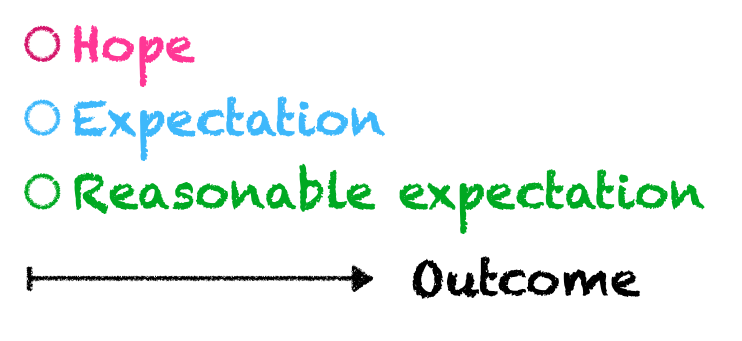
Wait, are you sure you know which order you should put them on this axis? What is your mindset? What trade-off are you willing to make? What are we even talking about; is that vital, or plain superficial aspirations? Is that impacting only yourself? Your loved ones? People who work with you?
Let’s call a cat, a dog
Might be a good time to figure out what’s what. Let me spare making up definitions, I’ll just refer to the Cambridge Dictionary for the first two:
- Hope, noun: a belief or confidence that good things will happen in the future
- Expectation, noun: a strong wish or desire for sth to happen.
Oh wait, there are more definitions to “expectation”:
- the state of expecting
- what is expected
Darn, I’m already stuck into having to take a stand for one of them. Well, let me refer to one of those occasions when a boss told me “I expect you to…”. It didn’t sound like I had much of a choice. That also applies to when my parents were saying those words, too. Ok, let’s make this one up:
- Expectation, noun: a strong objective for sth to happen, set by someone who’ll get mad at you if you don’t achieve it.
Note how this even works when the “someone” is yourself. We’ll get back to that later.
There’s still one missing definition: “reasonable expectation”. Aaaah, some qualitative adjective. Beautiful. No effing way you’ll ever get a proper definition for that one. It’s subjective.
Here comes the bias
Even in the very first days I had to set objectives (remember, that experience when I was a student?), I’ve had quite some arguments with my “staff” (understand “unfortunate other students who also wanted to take part in this venture, but had different aspirations than me”). As a founder, a business manager, a product manager (collectively “a creator”), a people manager, or a manager of your own self, your worst enemy is also yourself.
Your key driver isn’t the same as the person next to you. You are not the same person as the person next to you. You sometimes don’t even know who you are and what you need.
Have you ever faced that situation of “how could you imagine that I expected you to be happy with such a result”? Most likely, you have, both as the person who said that, and as the person who heard it. I’ve written about OKRs in the past. Maybe some further thoughts there.
When I started thinking about and when I started writing this blog post, I was hoping to give clues and ideas on how to rank (hopes, expectations, reasonable expectations). That hope won’t come true; my expectations have changed. I’ll leave it up to you and just let you end up with more questions than answers.
Actually, that was still too easy. Is the world just one dimension?
Thinking in 2D
Using a bare (x; y) axis is far too restrictive to caption how things work. Let’s not burn ourselves some brain cells too fast, yet, and go one dimension higher.
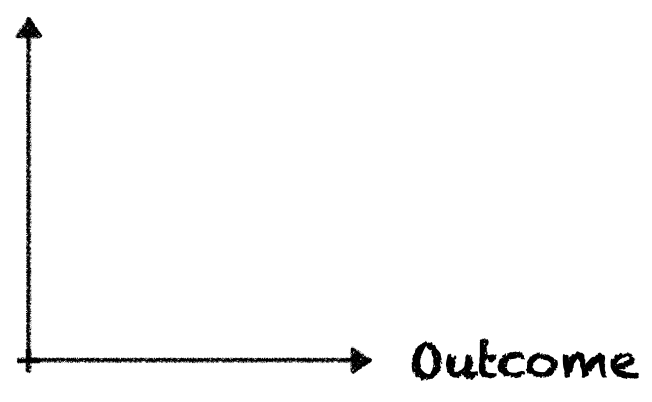
My engineering studies’ physics teacher would lynch me for not putting a label on the y-axis. I’ll plead not guilty since this very much depends on what we’re talking about. The x-axis is still what you’re aiming for. Whether in life, for your business, as objectives you’ve set for your teams, and more.
Here comes another bias
We’re all humans, you know. It’s fine if you realize you failed too, in the below.
I’ll appeal to some basic maths from high school. On the diagram below, is the red arrow longer or shorter than the orange one?
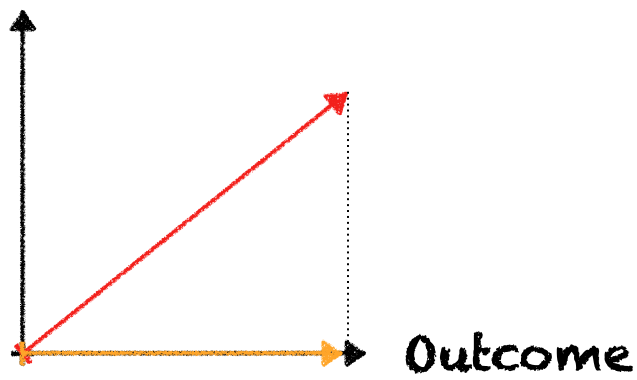
You know the funniest part of it? The red arrow is longer than the black one. And I haven’t even tried to set my purple, blue, and green circles here.
In whichever scenario we’ve listed before, have you ever tried this (sometimes heavy) mental exercise of realizing that the outcome you obtained was much greater than what you aimed for, even though your success criteria told you the opposite? From here, is the outcome wrong, or is the objective wrong?
I’ll share a shameful secret with you. At first, when I started drawing the diagram, the one-dimensional version, I thought of expressing effort or output, rather than outcome. Actually, in my mind, it’s not even relevant: you’ve reached a better outcome with less output? Good for you! I might even be jealous.
Thinking in 3D
Well, I’m sorry, as much as I’m sure you appreciate my amazing design skills, Keynote as a drawing tool shows some limitations, and I won’t make a 3D graph. Yet you get the point. Actually, just to make sure you get it: adding a dimension is not about going incremental in possibilities. It’s about going exponential.
Beyond
Now, imagine the number of parameters that should be taken into consideration if you had to write an equation out of the paradigm you’re in, to reach a specific outcome?
It is a terribly complicated job. We all do it, each and every day of our lives. Consciously or not. And there are countless parameters we just don’t have control over. And so it goes for our relatives and the people we work with.
What you have control over is your ability to measure the actual outcome, and plan, or empower people to plan, the next steps.
A few years ago, my wife put the magnet below on our fridge. At first, it felt naïve, trivial. I almost had the impression that a random LinkedIn post from my feed landed there. And I sincerely hope you don’t stop at that.
This is a message to all who deceive themselves*, while sometimes, a little tilt in perspective may unveil a hidden gem, an amazing achievement, and a next step.

* “deceiving yourself” also happens when you expect something out of someone, and that their outcome is much higher than you expected, even though your hopes are misplaced.

 Christophe Dujarric